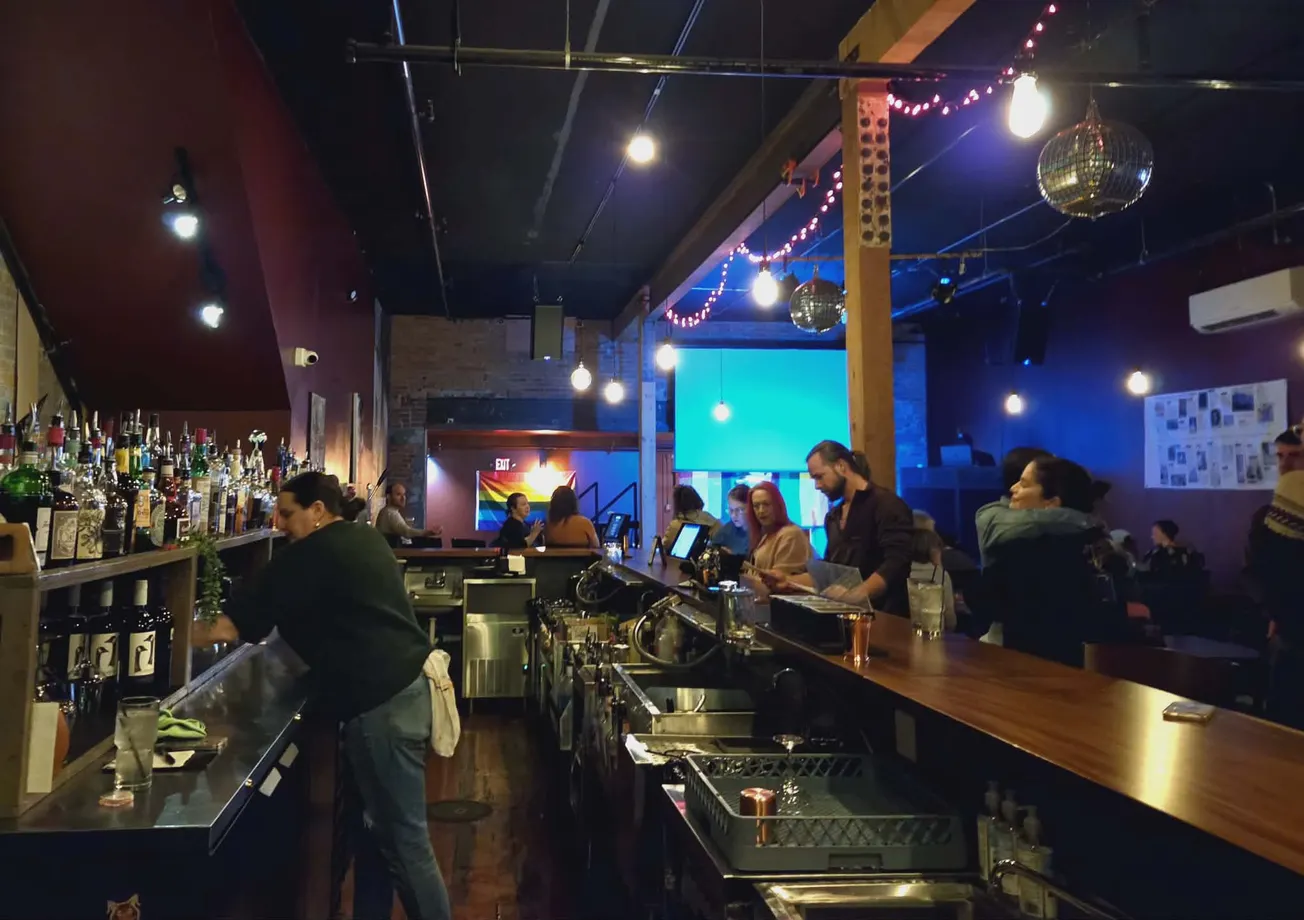
Spokane bars host gathering for 2SLGBTQIA+ legal debrief by Gonzaga Law’s Lincoln LGBTQ+ Rights Clinic and the Spectrum Center
To understand a gay bar is to understand far more than what’s on the food and drink menu.
A gay bar is not defined by alcohol, lighting, or music, but by infrastructure—by the way a community learns to organize itself when formal systems fail it, exclude it, or move too slowly to keep it safe. Historically, gay bars have functioned as many things at once: classrooms and town halls, stages and sanctuaries, places where information moved quickly and care moved quietly, long before any institution was willing to do either.
In Spokane—where queer life has often existed without institutional protection—that anatomy has been built and rebuilt over decades. Allen’s Tin Pan Alley, Irv’s, and Dempsey’s were among the city’s historic gay bars, serving as gathering places long before visibility came with any promise of safety. Often queer-owned and queer-operated, these spaces existed not as a branding choice, but as a necessity, shaped by the understanding that survival required proximity.
That lineage was fully visible on December 10, on a Wednesday night, inside nYne Bar & Bistro and Q Lounge on historic Sprague Avenue.
At nYne, the bar had been reconfigured not for spectacle, but for care. A complementary taco bar welcomed people in. Ample seating filled the room. A whiteboard stood ready at the front, and community leaders greeted attendees as they arrived, not to screen or police, but to welcome. The invitation had been circulated intentionally—shared directly with individuals and organizations and also posted publicly on social media—signaling that this was a space meant to be accessed.
The gathering was a 2SLGBTQIA+ legal debrief hosted by Gonzaga Law’s Lincoln LGBTQ+ Rights Clinic and the Spectrum Center. The conversation moved through healthcare access, education, and the legislative forecast before settling into a careful, accessible overview of the current state of transgender rights. State and federal litigation were discussed with enough grounding to understand not only what is happening, but why it matters, and how those decisions ripple outward into ordinary lives.
The room itself reflected the breadth of the community: teachers, nonprofit leaders, legal and medical professionals, veterans, and business owners, sitting together, taking notes together. Some of the most urgent guidance was also the most practical. Attendees were encouraged—plainly and without alarmism—to put estate planning documents in place, particularly given the legal vulnerabilities queer and trans people continue to face. Different avenues for filing complaints when rights are violated were also shared, demystifying systems that too often feel intentionally opaque.
This is one of the quieter, enduring functions of gay bars: knowledge circulation. Long before institutional support existed, bars were where queer people learned how to survive, how to prepare, how to warn one another. That role has not disappeared—it has simply adapted.
Later that same evening, the anatomy shifted, but remained intact.
At Q Lounge, a Pivot Open Mic unfolded under soft lights and open expectation. Hosted by Ani—who spoke easily and openly about her girlfriend being in the audience—the event was not explicitly labeled as queer, and that, too, mattered. The room drew people from across backgrounds and walks of life, creating a space where queerness was present, visible, and unremarkable in the best possible way.
The theme was the holidays, but the stories traveled far beyond any single tradition. Rose spoke of Christmas in Haiti. Jacob spoke of Christmas in Texas. Between them and others, the bar moved through geography, memory, warmth, loss, and longing, carried by vivid imagery—sounds, smells, rituals, absences.
An intermission divided the evening not as a pause in momentum, but as a breath. Time to refill drinks. Time to exchange quiet recognition. When the storytellers returned, the room felt ready.
Solidarity moved through the space without needing to be named. There was laughter—sometimes sudden and loud—and grief—sometimes held in silence. And there was recognition, the subtle understanding that our experiences differ wildly, and we still gather to hear them. This, too, is part of the anatomy of a gay bar: the ability to hold multitudes without flattening them.
Kitty Kane, the owner of both nYne Bar & Bistro and Q Lounge, understands this anatomy intimately. When I spoke with her, she was candid about the reality these spaces are facing. “The pandemic changed how people acted,” she observed, a statement that carried more weight than it first appears. Crowds are smaller now, people linger less, and spending looks different—not from disinterest or disengagement, but because economic realities have narrowed what feels possible, even in spaces people care deeply about.
nYne Bar & Bistro opened its doors in June of 2010. Thirteen years later, in the space formerly known as the Bartlett, Kitty opened Q Lounge as a deliberate counterpoint—an alternative to the bright, loud energy next door. Q Lounge offers food and drinks, with an emphasis on craft cocktails made by a small group of experienced bartenders who treat the work as, fittingly, a craft. When you walk in, the bar sits to the left, the stage anchors the back of the room, and beyond it, darts and a pool table invite people to stay.
Though Kitty is the technical owner, queer spaces have never functioned on ownership alone. There is a palpable sense of shared stewardship here, carried by staff, regulars, event hosts, and the people who keep showing up. This is not consumption. It is participation.
Gay bars are fragile ecosystems. Rising rents, economic strain, political hostility, and cultural shifts all threaten their survival. When a gay bar closes, a community loses more than nightlife—it loses institutional memory, informal care networks, and a place where survival knowledge lives.
Keeping these spaces open and accessible requires more than nostalgia. It requires showing up on quiet nights, supporting queer-owned spaces not only when they are crowded or celebratory, but when they are doing the slower, less visible work of care.
A gay bar is not where queer people go to disappear.
It is where they gather to prepare, to learn, to grieve, to celebrate, and to make sure they are not facing the world alone.
On December 10, on Sprague Avenue, the anatomy of a gay bar was fully visible—and it remained alive because the community chose, on an ordinary Wednesday, to hold it together.