
Table of Contents
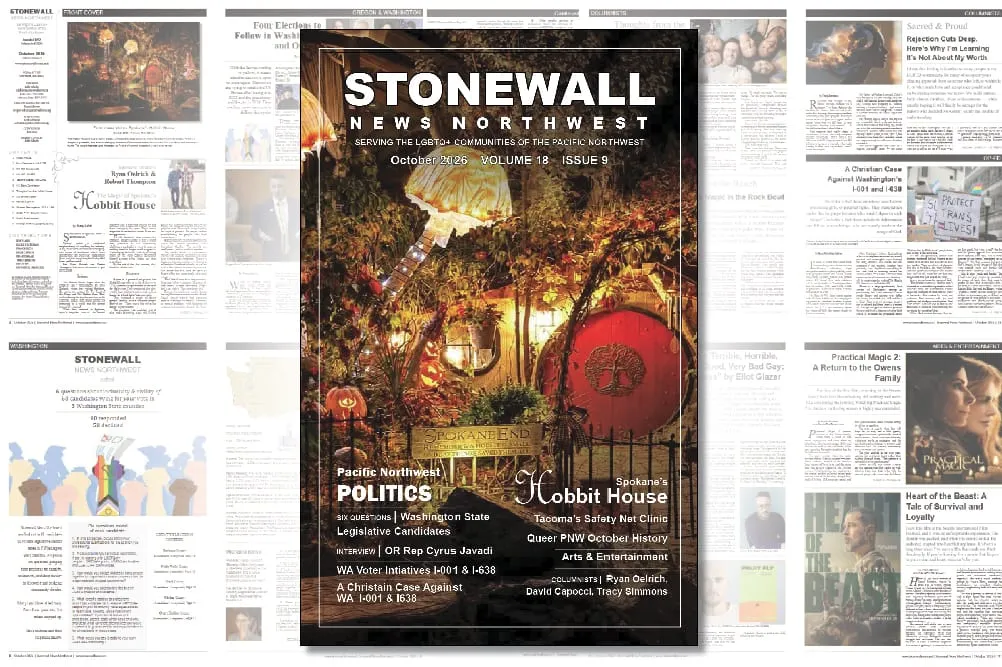
Stonewall News Northwest interviewed three key members of Just Out who share their history with the publication and what they're doing now.
Just Out co-founder and publisher (1983-1999) Renee Lachance, art director Rupert Kinnard and second publisher (1999-2011) Marty Davis talked with Stonewall News Northwest. Jonathan Kipp, third and final publisher (2012-2013) declined interview requests.
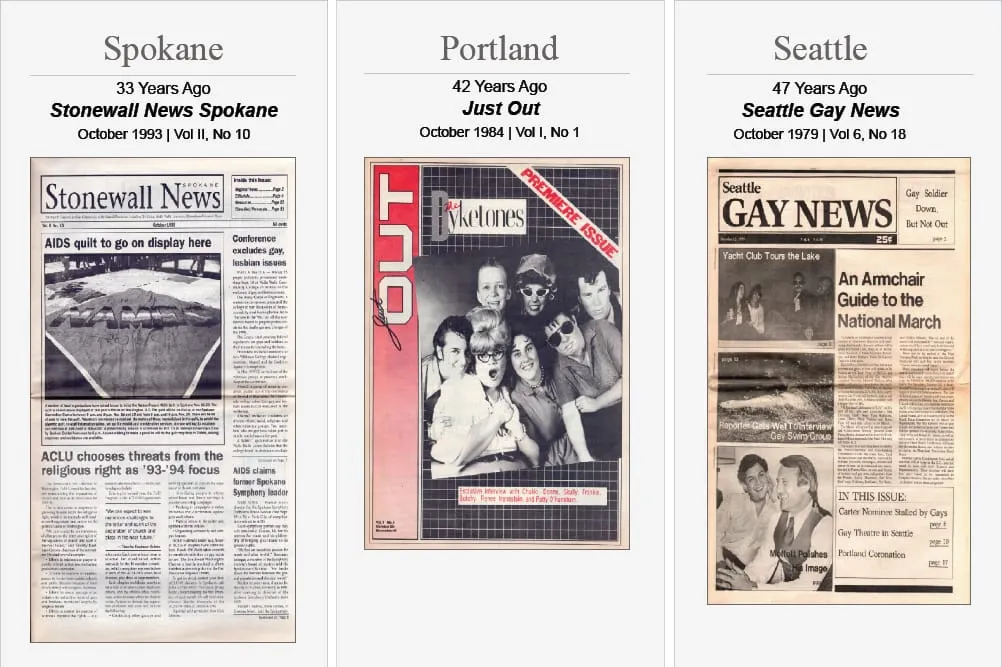
Before smartphones and social media feeds, LGBTQ+ people often found others like them through something far more fragile: a newspaper on a rack in a café, bookstore, or community center.
For thirty years, Just Out served Oregon’s LGBTQ community as more than a publication. It functioned as infrastructure by connecting people to news, resources, political movements, businesses, events, and each other. Published from 1983 to 2013, it became one of the longest-running LGBTQ newspapers in the United States — covering the AIDS crisis, major political battles over LGBTQ rights, and the collapse of print journalism now seen in the digital age.
What stands the test of time is not just that the paper existed, but the work that it did. Across three decades and changing leadership, Just Out consistently operated as a space for community-building at a time when those systems, now online, did not yet exist.
This story is about Just Out, but not just the words — it is about the people behind the scenes, building this infrastructure and community on the printed page.
Building Something Different (1983)
Just Out began in 1983 out of frustration and necessity.
Founder Renee LaChance, co-founder Jay Brown, and art director Rupert Kinnard were part of Portland’s LGBTQ media landscape at a time when representation was limited, controversial, and often contested. All three had been connected to a predecessor publication, Cascade Voice, that became a flashpoint for disagreements over racism, inclusion, and community accountability.
Kinnard recalls tensions around how the publication responded to a racist incident at a Pride event, and broader dissatisfaction with how LGBTQ communities were being represented in print. Rather than continue within that structure, the trio chose to build something new.
“We wanted to start a paper that more embraced the diversity of the community,” Kinnard said.
In August 1983, LaChance and Brown sat at Portland’s waterfront with a thesaurus and chose a name: Just Out.
Within weeks, the first issue was printed.
From the beginning, the paper was designed to do more than report news. It was meant to reflect a community still forming itself publicly—one that needed visibility, information, and connection in equal measure.
More Than a Newspaper
Across every interview, one idea repeats with unusual consistency:
Just Out was a resource for finding people.
Every issue included community calendars, organizational listings, advertisements, and resource guides. Readers could learn where events were happening, which businesses were safe, what political groups existed, and how to connect with services and support networks.
“You could look at the paper and see where you were safe in the community as an LGBTQ person,” LaChance said.
For readers outside Portland, those pages often meant something much larger.
LaChance recalls hearing from people who discovered Just Out in small-town libraries or community spaces and realized, sometimes for the first time, that they were not alone.
“They would say, ‘I didn’t know there were other people like me,’” she said.
Kinnard described LGBTQ+ newspapers of the era as “the community’s lifeblood.”
“We would get together for Pride,” he said, “and then throughout the year, the newspaper is where we got all of our information.”
Before the internet, this reliable, tangible communication mattered in concrete ways. It told people where to go, who to call, and which spaces offered safety or belonging.
Crisis, Visibility, and Political Survival
The paper’s earliest years coincided with the emergence of the AIDS crisis, which reshaped LGBTQ+ life across the country.
Just Out became a source of information, advocacy, and visibility at a time when mainstream coverage was often limited or harmful.
At the same time, Oregon’s LGBTQ community faced escalating political attacks, culminating in Ballot Measure 9 in 1992, which sought to embed anti-LGBTQ language into the state constitution.
LaChance describes this period as one that required deep coalition-building across communities.
“We had to do real community organizing,” she said.
Just Out helped connect organizations, amplify messaging, and distribute information during the campaign. The fight against Measure 9 became one of the defining political moments in Oregon LGBTQ history.
LaChance also argues that earlier work in the 1980s—particularly around inclusion, racism, and coalition-building—helped make later political organizing more effective.
Art, Identity, and Visual Language
For nearly two decades, Rupert Kinnard served as Just Out’s art director, shaping how the newspaper looked, felt, and communicated visually.
Early production was limited by technology and budget. Color was scarce. Layout was manual.
“I was always interested in seeing what I could do with that color and black,” Kinnard said.
Despite constraints, the paper quickly developed a recognizable visual identity and earned early recognition for its design work.
For Kinnard, the paper represented both artistic experimentation and community purpose.
Kinnard’s “Cathartic Comics,” featuring Brown Bomber and Diva Touché Flambé, ran in the paper and became a landmark in alternative queer media—centering race, sexuality, and politics through humor and critique.
“It challenged the community to not be one-dimensional,” he said.
Growth, Professionalization, and Peak Influence (1999–2011)
In 1999, ownership of Just Out transitioned to Marty Davis.
Davis arrived at the paper after leaving a corporate career and initially taking a sales role with Just Out. While originally as a temporary job, it became long-term stewardship.
“I kind of took over,” she said.
Under her leadership, Just Out expanded significantly. At its peak, the publication employed a staff of roughly a dozen people, including editors, designers, columnists, and sales staff. Distribution widened, production modernized, and the paper became a recognized voice in Portland’s LGBTQ+ and broader progressive media.
This era also reflected broader cultural shifts. National brands began targeting LGBTQ+ consumers. Advertising expanded beyond queer-owned businesses into mainstream companies seeking “lavender dollar” markets.
Davis describes the period as both influential and unstable. It was defined by growth, but also by dependence on shifting advertising ecosystems.
“We were respected,” she said. “We were a voice in the community.”
When the Model Broke
As the internet expanded, the functions the newspaper once served migrated online. Classifieds disappeared. Personals moved to digital platforms. Community calendars shifted to websites and social media.
Then came the 2008 recession, which sharply reduced local advertising revenue.
“I tried to keep it going for three years,” Davis said. “It wasn’t sustainable.”
The financial pressure reflected broader changes across the publishing industry, but smaller community newspapers were especially vulnerable. The economic foundation that had sustained Just Out for decades effectively dissolved.
“It was miserable,” Davis said. “I should have shut it down sooner than I did.”
Jonathan Kipp bought the publication and from 2012 to 2013, he was the editor as the newspaper published its final editions.
By 2013, the paper had ceased publication.
What Remains
Today, the racks are mostly gone. The personals are gone. The classifieds are gone.
But the people remain.
After Just Out closed, Marty Davis shifted from print to digital media, continuing her long-standing work connecting and informing the Pacific Northwest LGBTQ+ community. She created Shout Out, a Facebook page that promotes news, stories, events, and celebrations across the region and has grown to roughly 11,000 followers. The page functions as a digital continuation of what Just Out once provided in print—amplifying community information, highlighting local voices, and keeping people connected across cities and towns. In many ways, it reflects a direct adaptation of the same mission, translated into the speed and reach of social media.
Rupert Kinnard continues his artistic work, including a major retrospective of his decades-long comic practice. His work featuring Brown Bomber and Diva Touché Flambé remains a foundational contribution to LGBTQ representation in comics. In 2025, a retrospective collection of his work was nominated for a Will Eisner Comic Industry Award, one of the highest honors in the field of comics.
Renee LaChance continues writing and working on community-focused projects rooted in storytelling and collective memory. After Just Out, she operated a motel in Yachats that became a gathering place for retreats and community events, extending the same impulse to create spaces for connection beyond print.
The tangible memory of Just Out for these people is not nostalgia for the printed page, but recognition of the doors it opened.
Just Out was never only a newspaper. It was a system for connections.
It helped people find the spaces they needed when they had no alternative. It created shared community across cities in a time when such spaces were often scarce, contested, or hidden.
In the media age, information is abundant. Connection is constant. As a byproduct, intentional community infrastructure is harder to see—and harder to sustain.
The memories of Just Out remind us that communities do not emerge automatically.
They are built—carefully, imperfectly, and persistently—by people willing to create the spaces where others can belong.
Just Out was a newspaper, and a lifeline.



Online issues of Just Out:
Stonewall News Northwest LGBTQ+ Pacific Northwest Publication Archive:
 Stonewall News Northwest
University of Oregon, Historic Oregon Newspapers: https://oregonnews.uoregon.edu/lccn/2013202554/
Just Out issues from June 16, 2011 through February 1, 2013: https://issuu.com/justout
More information about Just Out:
Wikipedia: https://en.wikipedia.org/wiki/Just_Out
Portland Design History, Just Out: https://www.portlanddesignhistory.com/post/just-out
More information about Rupert Kinard:
Wikipedia: https://en.wikipedia.org/wiki/Rupert_Kinnard
Portland Design History, Rupert Kinard: A Superhero in His Own Right by Melissa Delzio: https://www.portlanddesignhistory.com/post/rupert-kinnard-1