I was raised in a faith community that believed homosexuals are equivalent to murderers. Some years after I came out, my mother sent me a letter and two UPS boxes containing everything from my childhood — baby photos, a stamp collection, matchbox cars — and told me we could no longer be in contact. That was the formal end of my relationship with the faith I grew up in.
But it was not the end of my relationship with faith.
I am a religion reporter. I have spent more than 20 years walking into houses of worship across the Inland Northwest — mosques and temples and cathedrals and storefronts — documenting what faith communities actually do, as opposed to what their worst representatives claim they stand for. And what I keep finding, again and again, is this: there are faith communities out there actively fighting for us. Not despite their faith but because of it.
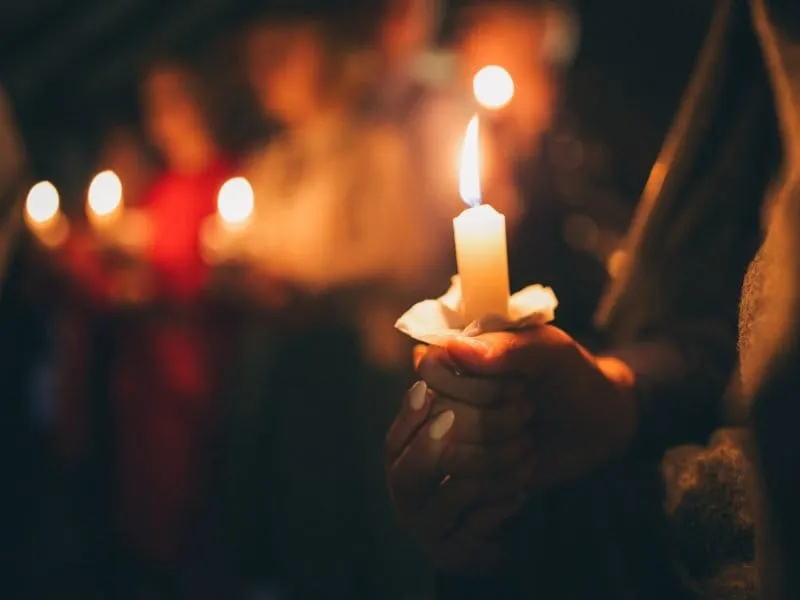
Let me show you what I mean. In January, on a cold evening in downtown Spokane, about 200 people gathered at the Rotary Fountain in Riverfront Park. They carried flowers and candles and walked 10 blocks through downtown and back. Some were Buddhist. Some were Christian. One man was a Rosicrucian, who came with his dog. There were Tibetan nuns from Sravasti Abbey. There were people who probably couldn’t tell you exactly what they believed — only that they believed in this.
They were honoring a group of 20 Buddhist monks who had just completed a 2,300-mile peace walk from Fort Worth, Texas, to Washington National Cathedral — 108 days, sunrise to sundown, walking, as their leader put it, “to find peace for ourselves, to share that to our nation and the world.”
Ven. Geshe Thupten Phelgye, who founded the Universal Compassion Foundation in Spokane, flew to the East Coast just to walk with the monks for a single day. He came home with blisters on his feet. “Peace begins from ourselves,” he told one of my reporters from FāVS News. “We have to share peace, love, and compassion and practice humility, compassion, and forgiveness.”
Around the same time, Catholic theologian Tracy Sayuki Tiemeier spoke at Gonzaga University about what she calls moral imagination — the story we tell ourselves about strangers, about who deserves dignity and who does not. Her grandparents met while interned at the Heart Mountain Relocation Center during World War II, locked away because they were seen as “not like us.” That history shaped her life’s work.
“We can engage with faith in a way that embraces difference, and we don’t have to be afraid of it,” she said. “They don’t have to look like us, they don’t have to pray like us, to be treated with respect.”
I have heard versions of that sentiment in congregation after congregation across this region. It is not naive. It is not performative. It is people putting their deepest convictions on the line — showing up, speaking out, welcoming in.
I know that many of us in the LGBTQ+ community have been hurt by religion. I was. The wounds are real and they run deep. But I also know, from two decades of reporting, that the faith communities making headlines for exclusion and cruelty are not the whole picture. Not even close.
There are people of faith who see you, who claim you, who are fighting alongside you. They are in Spokane and Moscow and Newport and Seattle and towns you’ve never heard of. They are walking 2,300 miles and lighting candles in the cold and asking hard questions in lecture halls.
They are already doing the work. And they are doing it, in part, for us.