
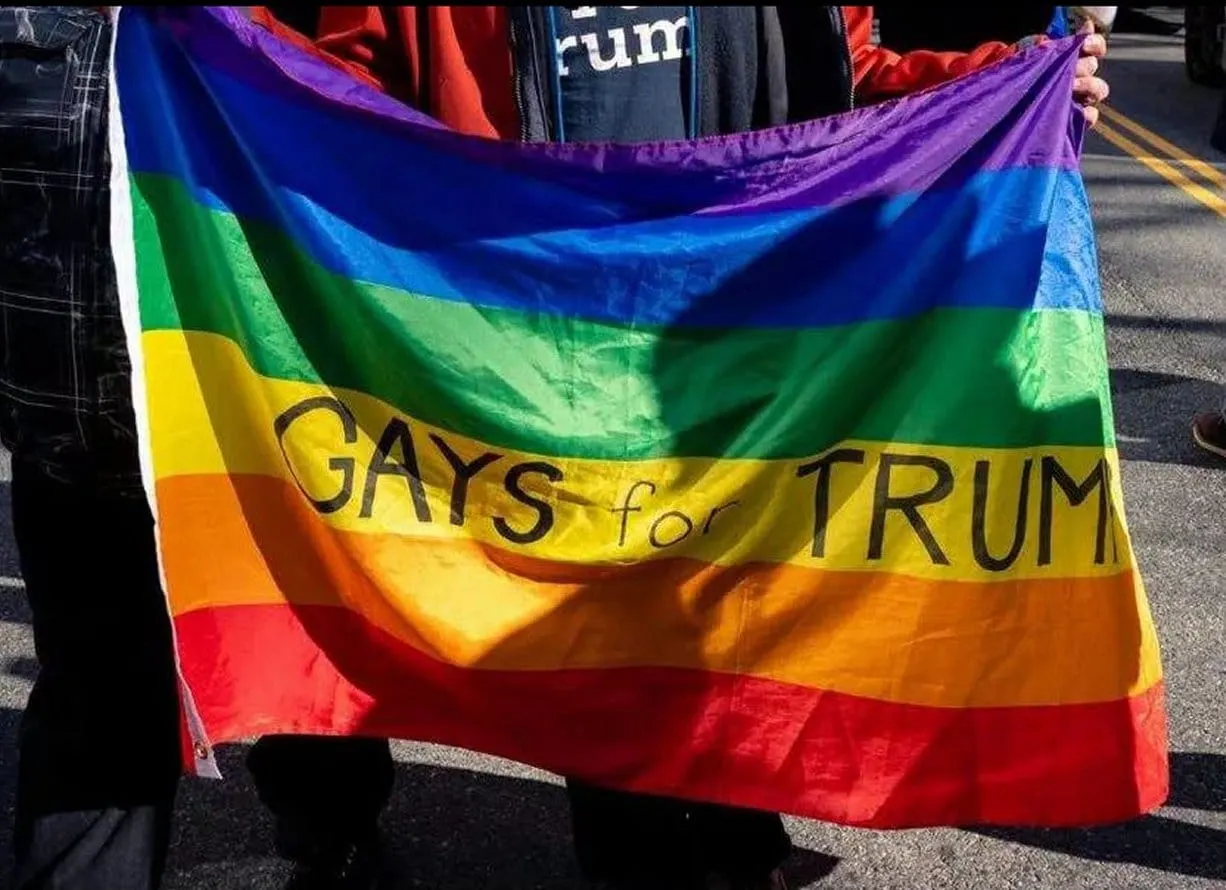
It might not be a great loss for transgender people. But it is a reminder that courage, solidarity, and moral clarity are in increasingly short supply — in ways that echo darker moments in history.
This update is provided by Fabrice Houdart, consider supporting his important work.
The news this week: the Log Cabin Republicans — the organization representing LGBT conservatives and their allies within the Republican Party — has voted to drop the T from its mission.
Ross Hemminger, the group’s President and a former pharmacists' PR guy, laid out the reasoning two days ago in an op-ed for Townhall, the conservative news and opinion site.
His justifications struck me as disingenuous. First, the invocation of a “moral center” and a decision to “move forward with clarity” — when the move so plainly reads as opportunistic and self-serving. Second, the long list of grievances against the transgender movement is offered as the reason to drop transgender people from the project of making the Republican Party more inclusive — when that, too, feels like a pretext rather than the real motive.
In fact, the op-ed reads as flippant, almost impulsive. It really reads as: this got complicated for us, so we caved in and built a morality narrative to justify the exit after the fact. The window dressing isn’t pretty.
On the underlying moral question, there is no ambiguity. Anyone who has actually spent time with transgender people knows, intuitively, that a decent society must find ways to support their pursuit of a livable life. The conversation often comes down to something as stark as “it was either I transitioned, or I killed myself.” However you come down on youth trans healthcare, women-only spaces, sports, or self-ID — a movement does not get to respond to that kind of testimony by walking away. There is nothing capricious or pernicious about the movement for the inclusion of transgender people in society. Breaking the family was never an option.
In dropping the T, Log Cabin Republicans gave up a founding value of this movement — solidarity — in exchange for their usual crumbs: a gala with Melania. Solidarity across the letters. Solidarity across gender. Solidarity across generations. Solidarity across classes.
The announcement felt timely for me because I just watched Rays and Shadows (Les Rayons et les Ombres, 2026) this week, which tells the true story of the journalist Jean Luchaire during the German occupation of France. It traces his slide into collaboration — driven less by ideology than by ambition, vanity, and greed, and cemented by his friendship with the German ambassador, Otto Abetz. Underneath the period drama, it’s really a study of how the professional class becomes complicit in atrocity: not through conviction, but through self-interest and moral cowardice, one small accommodation at a time.
More than eighty years after the war ended, that same test — do the right thing, or do the easy thing — is showing up again as a daily American dilemma. If the Dialog leak this past June taught us anything, it’s that today too principles are surprisingly negotiable, even for people who should know better.
There is a lesson here for each of us: we will not get out of our current predicament unless we are willing to pay a personal price—to risk our job, our money, our friendships, even our own comfort.
Unfortunately, Log Cabin Republicans aren’t the only ones weighing whether to leave transgender people behind before the midterms. Some Democrats are also signaling they’re ready to soften or sidestep trans rights, and it’s an open question how that will play out.
The work ahead for advocates is to reframe LGBTQ+ interests in terms that resonate across the political spectrum. Sarah McBride’s call for conversations that persuade comes to mind. There’s also a real lesson in the long fight to include transgender people in the Employment Non-Discrimination Act (ENDA), the reminder that movements must have the room to articulate a strategy that meets the moment.
Indeed, cowardice isn’t confined to the conservative side today. Our own movement has its share of leaders who can be equally opportunistic — willing to trade away hard-won objectives to appease fringe voices, in exchange for the security of comfortable salaries and the vanity of appearing enlightened. In America today, courage is in short supply.
There’s actually a third argument buried in Hemminger’s oped: “Gay men and women are losing public support across the country.” The implication is that we’re facing a fresh wave of hostility, a tide that has turned. I don’t think that’s quite right. What’s actually happened is that a lot of the country has heard our stories and remained unmoved — and the far right is organizing, deliberately and effectively, to take our rights away. As CNN points out, today’s topic is trans issues, but tomorrow it will be surrogacy and so on. We should always expect to operate in a world where hostility toward us is a permanent feature, not a passing backlash. We are a relatively small, and at times unpopular, minority, and a strategy built on the assumption that public sympathy is trending our way is a strategy built on sand.
Luchaire didn't set out to become a collaborator; he drifted there, one flattering invitation at a time, telling himself a story about pragmatism until the story was all that was left. That's the danger in front of us now — not a single dramatic betrayal, but a series of small individual decisions, dressed up as clarity, which ultimately break the movement. The real test isn't whether we can name our values when it costs nothing. It's whether we hold them when the room gets uncomfortable, and the door out is right there, and it would be so easy to take it. Solidarity is what's left when everyone in the room has a good reason to leave.