
Table of Contents
Looking for stories of woodsy whimsy and being as gay (happy) as Miss Bennet from Pride and Prejudice? Even better: stories that come from your own town?
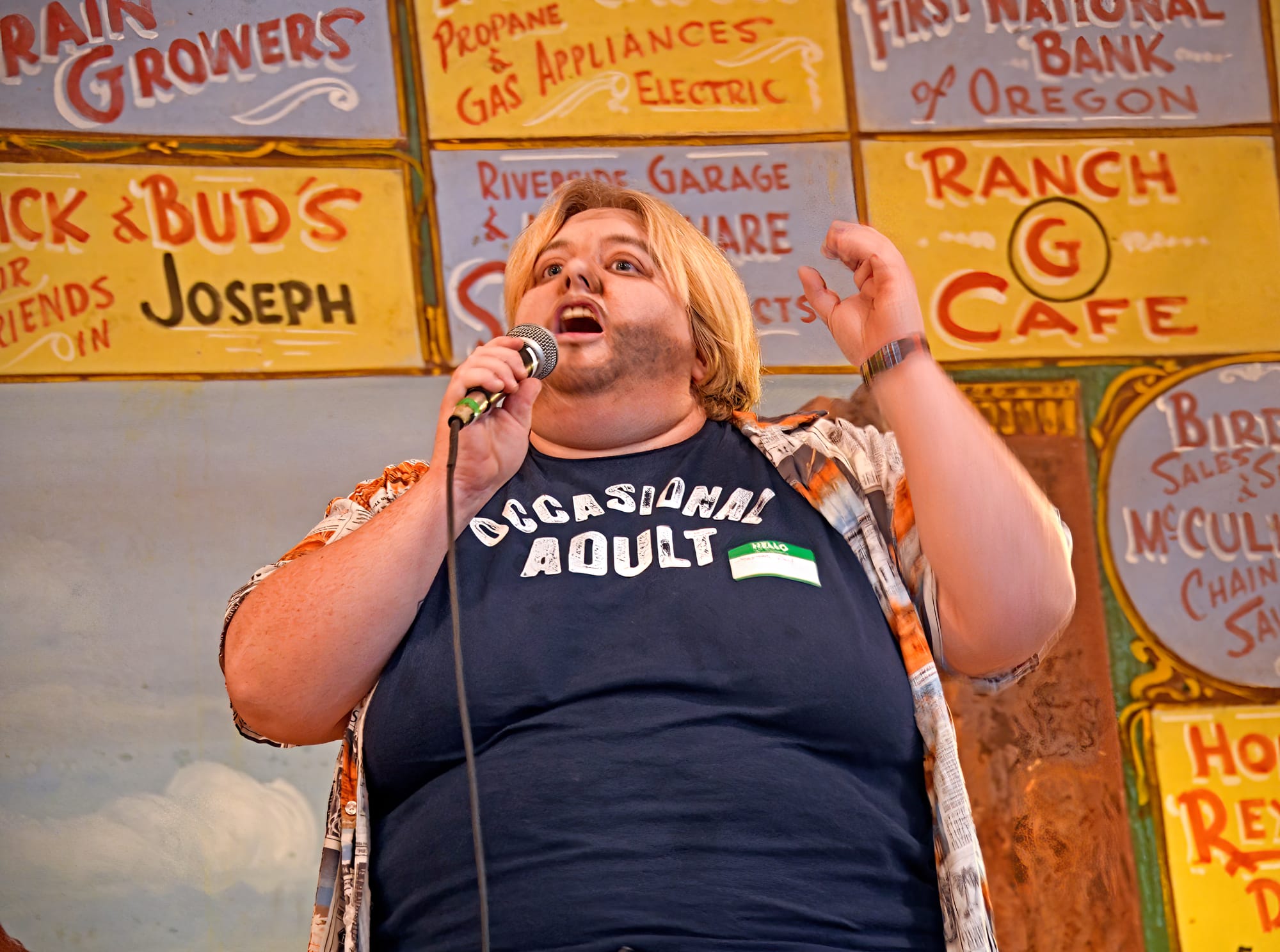
No, it’s not the new TJ Klune novel. These tales are as real as can be. This is the Rural Queer Open Mic, a project by Marika Straw and co-hosts AJ and Dani Savage, a traveling initiative that brings LGBTQ+ voices, creativity, and community building to towns where people often say such spaces could never exist.
There are no rules at this show. All are welcome. In fact, Straw even says some people bring their pets (one time, a friendly guinea pig made an appearance!), so be sure to bring your whole motley, fluffy, and friendly crew to the next performance.
Over three weeks (July 7–26, 2024), the tour hit 11 towns, ranging in size from just over 2,000 to just over 33,000. From Wallowa County to Brookings, from Newport to Walla Walla, it popped up in Grange halls, straw-bale octagon farmhouses, art galleries, cultural centers, and even the basement of a Queer teen program. In total, 215 people (and at least one guinea pig, a kitten, and a magic white rabbit) came out to listen, sing, read, laugh, and dance. Their ages spanned from toddlers barely learning to clap to elders in their eighties who’ve seen it all before.
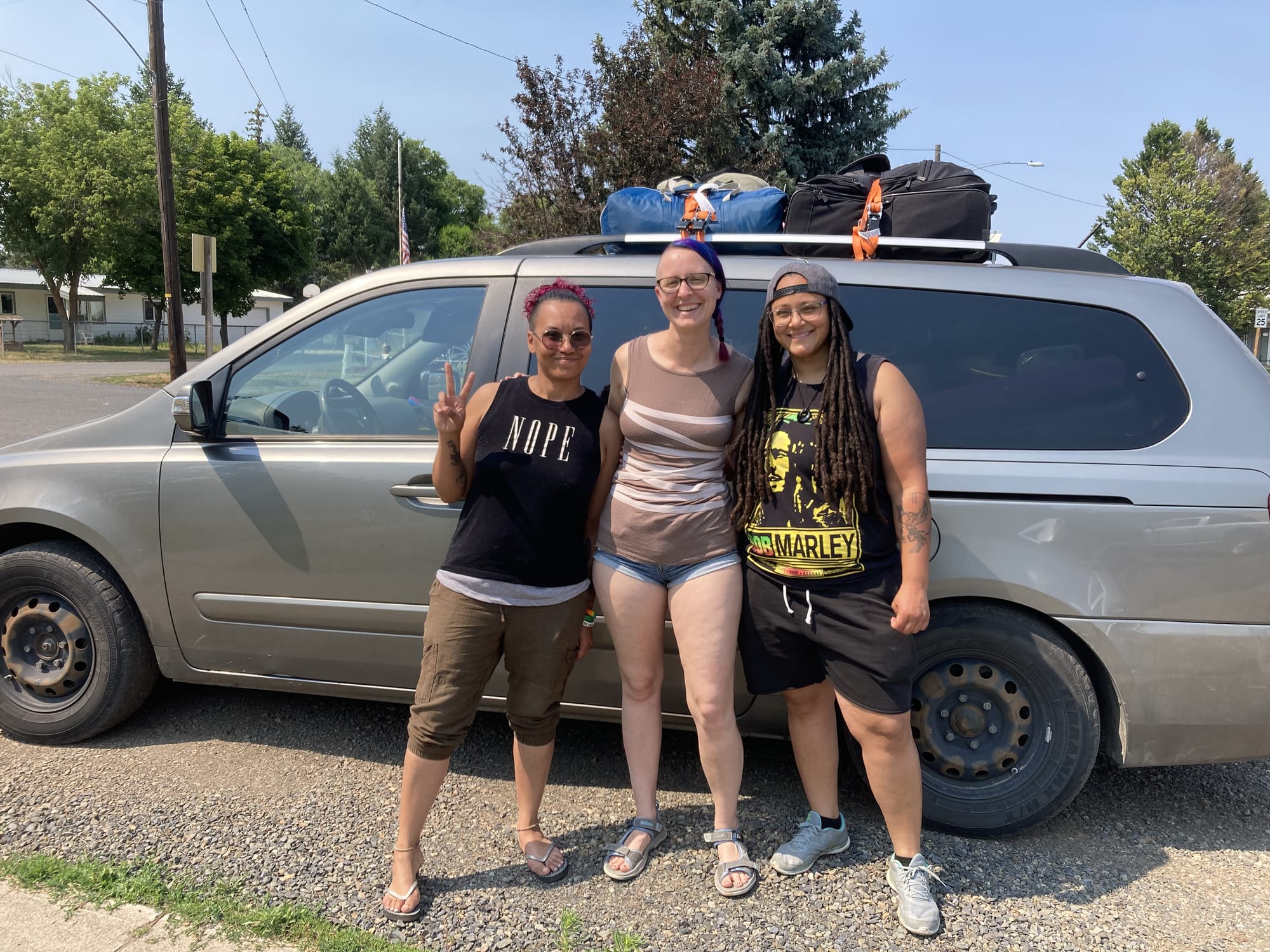
At the heart of the chaos were three humans, collectively known as “The Fruit Snaxxx”: Marika, tour emcee, van DJ, manager, heavy lifter, spontaneous detour guide, chronic oversharer, asker of embarrassing questions at the exact wrong time; AJ, merch queen, massage therapist, lodging scout, keeper of snacks, provider of perfectly timed one-liners, guardian of everyone’s posture; and Dani, van organizer, sound wrangler, safety planner, country driver, eye-roller-in-chief, getter-of-Marika-to-shut-up. Together, they schlepped gear, wrangled sound, stretched budgets across the state to make rural Queer magic happen.
And you can help that magic happen again in 2026.
The trio are working on reinstating the tour for the upcoming year, but they need some support. Marika says they are seeking new tour partners, collaborators, and facilitators, who must be Queer and live in rural areas. Potential collaborators who are BIPOC are especially encouraged to reach out to ruralqueeropenmic@gmail.com.
The vision
The idea was simple: create spaces in small towns where Queer people could gather, perform, and be seen. “Every single one was beautiful and unique,” Marika said.
Each night followed a rhythm:
· A local opener, paid for their time
· An open mic for music, poetry, storytelling, and comedy
· A “collaborative storytelling” activity with a happy Queer story (with the motto “If it’s not happy, it’s not over yet”)
· Anonymous question prompts read aloud onstage
· Chair massage by AJ, for a donation
· A closing set by Marika
Marika says the idea for the Rural Queer Open Mic was a result of her own experiences growing up in the country. When she was young, especially in spaces where LGBTQ+ narratives weren’t necessarily the norm, she craved space for unchallenged creativity.
“I’m a bitter, stubborn person. I don’t give in,” she said about herself.
But that stubbornness paid off. Marika was able to launch her own music career in her hometown, where she felt less pressure than in a big city.
“I'm Nonbinary, and it is a huge challenge to be properly gendered while performing, especially in the rural spaces I am in most often,” she said. “It's also regularly stressful to discern what commentary about my music will be safe and comfortable to share and what will not in specific spaces or at specific venues. The Rural Queer Open Mic was also a space for me to practice performing my own music and sharing the real stories behind my Queer love songs in a safe, affirming environment.” (Be sure to catch some of Marika’s tunes at https://marikastrawmusic.com.)
The shows
Each stop had its own flavor:
· Wallowa County: A blue silk shirt, a platypus love story, and a ring pop with blue lips. A collaborative story turned delightfully weird, capped off with the now-infamous line: “Thank you for once again caring about the moisture on my body.”
· Ontario: The smallest but possibly most unforgettable crowd: twelve teens and three adults. The highlight? A performance of “Banana Man,” complete with backup dancers, followed by karaoke of Chappell Roan’s “Pink Pony Club.” Someone even asked (anonymously, of course), “Did you meet the cutest t-girl in Ontario?”
· Walla Walla: The biggest show of the tour. Forty to fifty people packed into a gallery, plus a fashion show with hand-painted jackets, a set from Clownfetti the DJ, and more poetry than anyone expected — including verses in Spanish. It was also the night of some of the heaviest stories, including one about surviving queerphobic violence and then returning years later to start Walla Walla Pride. Healing, catharsis, joy — all in one room.
· Brookings: On a foggy coastal night, a teen showed up with a newborn kitten; the opener played her first-ever gig, watched proudly by her parents; a Lesbian poet read to her lover and sealed it with a kiss under the tour banner; and somewhere in the crowd, someone decided to start a Queer soup potluck.
· Newport: At the Performing Arts Center, by the end of the night, ten people had walked into the building for the first time, and at least one left dreaming of starting more participatory art events.
· Astoria: Sweetest moment of the tour: a coming-out celebration for a teen named Hope, complete with cheering, hugging, and more than a few tears.
· Welches: The smallest show of all, just a handful of folks in a coffee shop. Proof that numbers don’t matter nearly as much as stories told.
The stories
If the tour had a currency, it wasn’t ticket sales or merch. It was stories.
There were the collaborative ones: fairy tales about Gay fairies founding GSAs, or platypuses falling in love. There were anonymous questions, ranging from serious to ridiculous: “What’s your favorite pick-up line?” “Are you giving or receiving?” “Is my lipstick messed up?”
There were personal revelations: Someone said, “I felt most Queer when I was pregnant.” Another said, “I hadn’t seen anything explicitly Queer in nine days” and pulled their car off the Oregon Coast highway just to come in. A teen in Brookings quietly realized they weren’t alone.
And then there were the absurd moments, the ones that stitch a tour together: Dani cracking crab in a hotel bed. Eggs sliding off the van roof. A bear wandering outside the bar after a show. Marika yelling “Are you single?” at the exact wrong time.
By the numbers
· 11 towns across Oregon and Washington
· 215 attendees total, aged 2 to 80+
· Populations ranged from 2,071 (Cave Junction) to 33,339 (Walla Walla)
· Funding: $5,000 from the Pride Foundation, $2,500 from the Oregon Community Foundation, $1,355 in private donations, plus in-kind support (sound system, van use, lodging, meals, pet care, herb bundles, and more)
· Zines: 50 copies of 2SLGBTQIA+ sex ed zines donated to each location
The lessons
Marika said some lessons from the trip were logistical: The van was too small. Never, ever put the mics in front of the speakers. Rest days matter.
Others were deeper:
· Messiness works. Perfection doesn’t build trust — vulnerability does.
· Rural Queer people don’t just need city-based events. Sometimes, the most radical act is showing up where no one expects you.
· Joy multiplies. A Queer teen open mic in Lincoln City spun off from the show. A soup potluck idea was born in Brookings. Artists played their first gigs and left with confidence to keep going.
A year later
Already, some of the spaces that hosted the open mic have shifted or closed: The apothecary in Brookings, a Queer youth program outside Portland, a shop in Astoria. The rural Queer community remains fragile, underfunded, stretched thin. But the connections remain: organizers reaching out months later, friendships formed, a PrideFest booking on the coast, the ripple effect of being seen.
In the end, the Rural Queer Open Mic tour wasn’t about perfect shows or packed houses. It was about gathering people. It’s a reminder to all of us that sometimes we don’t need words to share emotions. Sometimes performers and audience members didn’t even speak the same language, but it was clear that everyone in the room was there to appreciate the beauty of others’ stories, and hopefully be able to understand their own better along the way.
It’s also a reminder that performance doesn’t have to be perfect, that sometimes even the what seems like the darkest parts of us can create something beautiful. It’s a reminder that there should be spaces to channel one's creativity and identity wherever you go, and that that identity can be understood.
How you can help
You can support the Rural Queer Open Mic by following and sharing their work on Instagram @ruralqueeropenmic, donating via Venmo or PayPal through their Linktree, or contacting ruralqueeropenmic@gmail.com if you’d like to contribute in a larger way.
They’re also looking for host groups and locations (mostly in Oregon, Washington, and Idaho, though they’re open to suggestions), as well as new Queer rural partners, collaborators, and facilitators, especially BIPOC people. If you’re interested, you can connect with them by email or DM.
The magic
All in all, the Rural Queer Open Mic is an invitation to show the most simple, pure parts of yourself. By sharing those, we create environments in which people are more apt to be vulnerable, colorful and real.
So sometimes, all it takes is a wandering rabbit, a ringing chime, and a messy emcee shouting too loudly into a mic to remind us: rural Queer life is alive, and its stories are only waiting to be told.