
During the pandemic, I was diagnosed with heart failure after landing unexpectedly in the ER. The medical team was covered head-to-toe in plastic shields, gowns, and gloves. I spent hours alone in a dark hospital room. My husband wasn’t allowed to enter. I held onto my cell phone like a lifeline, but without a charger, the battery slowly drained. Staff kept promising to find one, but they were short-staffed and overwhelmed. Eventually, the screen went black.
And I remember feeling desperate—not just for answers, but for touch.
A hand squeeze. A reassuring arm. Some simple, human reminder that I mattered, that I wasn’t disappearing into the noise and machinery. But there was none.
When I was finally released, my husband wrapped his arms around me in the parking lot. In that moment, I felt like I was falling apart—and his touch was what held me together.
Human touch is one of the first languages we ever learn. Before we form words, identities, or meaning—we learn safety through being held. Touch tells us we exist.
I remember being at youth group as a teen playing hide-and-seek in the dark. A boy grabbed my hand and pulled me quietly into a small storage closet so we wouldn’t be found. It was completely innocent. But I remember everything about that moment — how alive and nervous and grateful I felt just being that close to another human. Feeling his arm around me as we were squished together in the dark. Feeling chosen for a moment. That split-second connection imprinted on me in a way I didn’t even understand until years later.
It lasted maybe three minutes. But it has stayed with me for decades.
That’s the power of human touch. Not romantic touch. Not sexual touch.
Just touch paired with presence — the recognition that another human wants you near them.
And yet in gay male culture, touch often gets tangled. Many of us grew up in systems that treated our bodies as shameful, our desires as dangerous, and our love as a threat. Some of us learned young that closeness could get us hurt. Many of us survived adolescence by pulling away, armoring up, or training ourselves not to need what humans need most: each other.
So today, I want to talk about something beautifully simple, and wildly underestimated:
Consensual human touch as healing, connection, safety — and resistance.
Why This Matters for Us
One in three Americans feels lonely on a weekly basis according to the American Psychiatric Association.
Gay men experience some of the highest levels of loneliness in the country. Studies show LGBTQ+ adults are nearly twice as likely to report persistent isolation. We crave brotherhood, tenderness, belonging — but have been trained to access it only through romance or sexuality.
We forget that touch itself can be sacred — separate from performance or expectation.
Hugging your friend for five full seconds.
Leaning shoulder-to-shoulder during a movie.
Lacing fingers with your husband, wife, or partner while walking down the street.
A friend silently placing a hand on yours during a hard moment.
These tiny gestures reset the nervous system. They tell the body: you’re safe, you’re real, you matter, and you’re not alone.
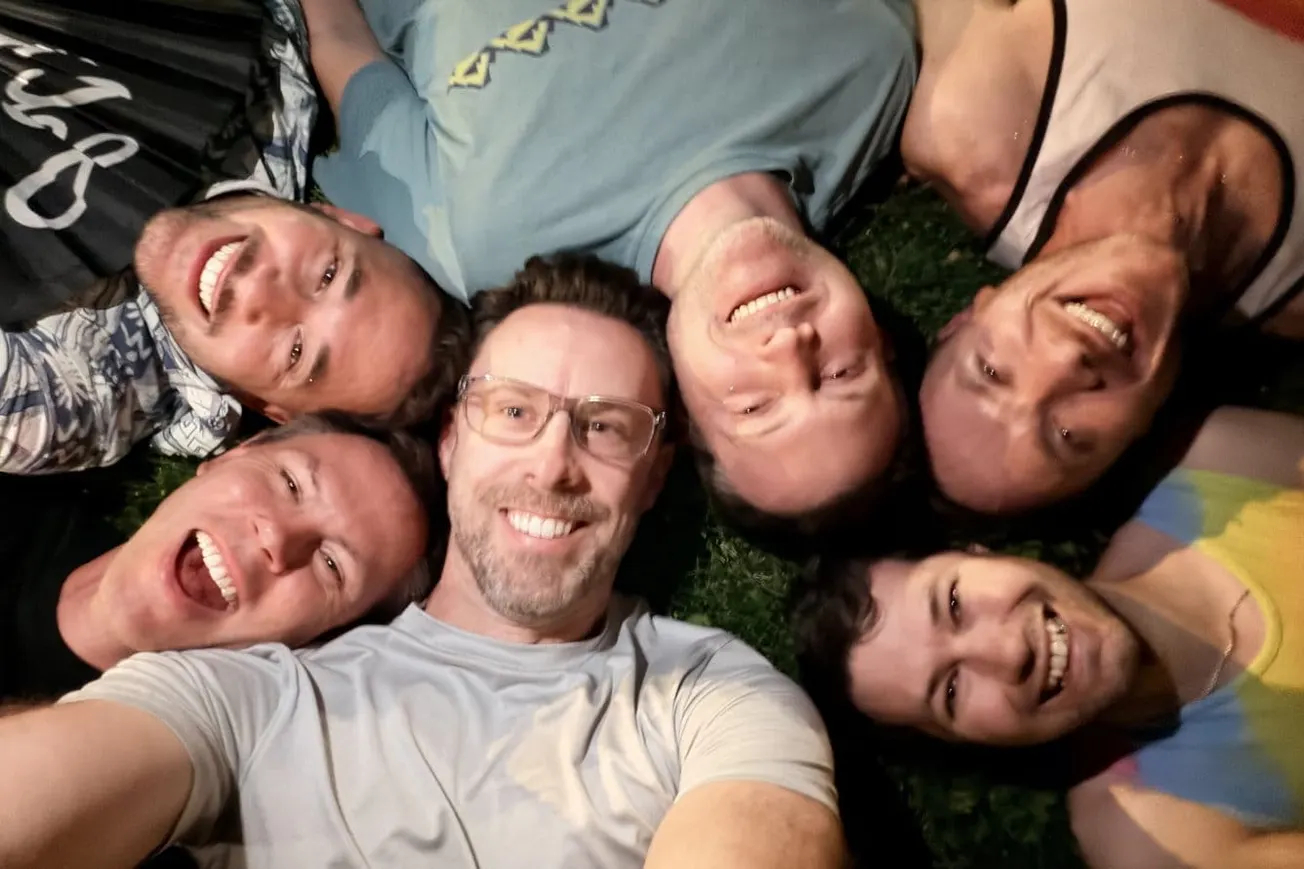
A Middle Earth Cuddle Puddle
For several months, once a week, two good friends came over and we worked our way through every version of Middle Earth — the extended LOTR trilogy, The Hobbit, the animated films, and Rings of Power. We’d pile onto the couch, laugh, debate scenes, and slowly melt into one collective Hobbit-loving human heap.
It was wonderful. Those nights I slept better. That was the healing power of a Middle Earth cuddle puddle.
I’m grateful for all the “cuddle puddles” and beautiful humans who have embraced me and allowed me to embrace them over the years.
Touch Is Medicine
This isn’t poetic metaphor — this is literal biology. Healthy touch reduces cortisol, blood pressure, anxiety, and even physical pain. It strengthens the immune system. It reminds the nervous system that the world is survivable. That you’re not alone.
For a community that has carried shame, rejection, violence, and loss — this is revolutionary.
We Need To Normalize Gentle Touch in Friendship
Some of my most healing moments were not conversations at all — but simple presence. Sitting next to my husband as we hand out dragon eggs at Hobbit Halloween. Hugging friends before and after sporting events. Leaning into one another during a game night on the patio.
The tight embrace of a loan officer friend before we watch a scary movie.
The energetic hug from a doctor friend before she beats me at kickball.
Touch bypasses shame.
It bypasses the fear-spinning mind.
It goes straight to the heart.
As I face new health challenges in the months ahead, I am thinking deeply about the touches I will need to heal — right alongside the treatments and medications. Our bodies heal better when we do not face the journey alone.
A Small Challenge
Reach out — literally.
Hug your friends longer (with permission).
Sit closer.
Put a gentle hand on someone’s back when they’re sharing something heavy.
Let your community not just be the people you know — but the people you feel.
Loneliness is not cured by logic.
Loneliness is cured by proximity.
Our community is tired.
Our community is grieving.
Our community is rebuilding constantly.
Human touch — safe, consensual, kind — is one of the most powerful tools we have to heal each other.
And it costs nothing.
We were never meant to go through this life alone.
We were meant to hold each other up — and hold each other close.
So put on an extended version of Lord of the Rings, have over a couple good friends, and invite them to enjoy a Middle Earth cuddle puddle.