How one spectacularly awkward attempt to make a new friend reminded me friendship is built, one tiny brick at a time.
I was trying to decide what to write about this month when my husband gave me one very specific piece of advice:
"Absolutely do not write about your incredibly embarrassing, painfully cringe-worthy attempt to make a new friend last month."
Naturally, that's exactly what I'm writing about.
This is how I process trauma: I write about it until it's funny. Or at least funny to everyone except my husband, who has to relive it every time someone says, "Hey, I loved your husband’s article." (Please DO keep telling my dear husband that you love my articles)
So let me tell you about my latest social catastrophe.
Because making friends as an adult is hard, and frankly, we don't talk about it enough.
About once a year my husband and I venture to our local drinkery and dance hall. We order an adult beverage, enjoy the music, and attempt to convince our bodies to move in rhythm.
My husband is exceptionally gifted at this.
He knows actual dances. He has the voice of an angel. He's graceful, coordinated, and somehow makes dancing look effortless.
Me?
I move like an arthritic buffalo trying to escape a tranquilizer dart. Thank goodness for liquid courage.
So there we were, enjoying the evening, when I spotted someone I know...but don't really know. We've crossed paths socially before, and I've always thought, That seems like an interesting and functional human. I'd like to know them better.
I tell my husband, "Let's go talk to that guy."
My husband strikes up a conversation first. They discuss social dynamics and other fascinating, intellectual things that people with functioning social skills discuss.
Then it was my turn.
Now, in my mind, I intended to casually express that maybe sometime we could get together and hang out.
What actually came out of my mouth, as confirmed by my horrified husband, was:
"Hey...wanna play Legos sometime?"
That's it.
No context.
No explanation.
Just the verbal equivalent of a socially awkward third grader asking the cool kid at recess to be best friends.
To his everlasting credit, he paused, looked mildly confused, and then politely said, "Sure."
He then returned to his friends, where I'm fairly certain the conversation immediately became: "Do you think 'playing Legos' is code for something?" or "...has that guy ever had a head injury?”
Meanwhile, my husband gently, but very quickly, escorted me away while whispering strongly,
"You CAN’T just ask someone you barely know to play Legos! That's weird!"
Sir. You have been married to me for over a decade. At what point were you expecting me to stop being weird? The answer to that is a much longer article and an ongoing conversation with my therapist.
For a brief moment I reflected on what I meant to say.
Perhaps something along the lines of: "We should get together sometime, enjoy a beverage, engage in a collaborative architectural design activity, and have some meaningful conversation. What do you say?"
Instead, I essentially yelled across the playground, "WANNA PLAY LEGOS?"
Honestly, it was probably more efficient.
But here's the surprising part. He actually said yes.
A few weeks later we got together, each built a Lego bonsai tree, and spent a couple of hours talking.
I learned he's a fan of marmots. We discovered we share a love for the same delightfully creepy horror movies. We laughed. We talked. I had a great time. I hope he did too. I sent him photos of Samwise the marmot who patrols our driveway.
Against all odds, and despite my sometimes complete inability to behave like a normal adult, I may have actually made a new friend.
Friendship is strange.
It's a mutual agreement to tolerate each other's weirdness, trauma-dump at unreasonable hours, split the cost of appetizers without keeping score, and become comfortable enough that silence doesn't need filling.
Making new friends is hard.
Keeping friends is hard.
Ending friendships is hard.
Putting yourself out there is hard.
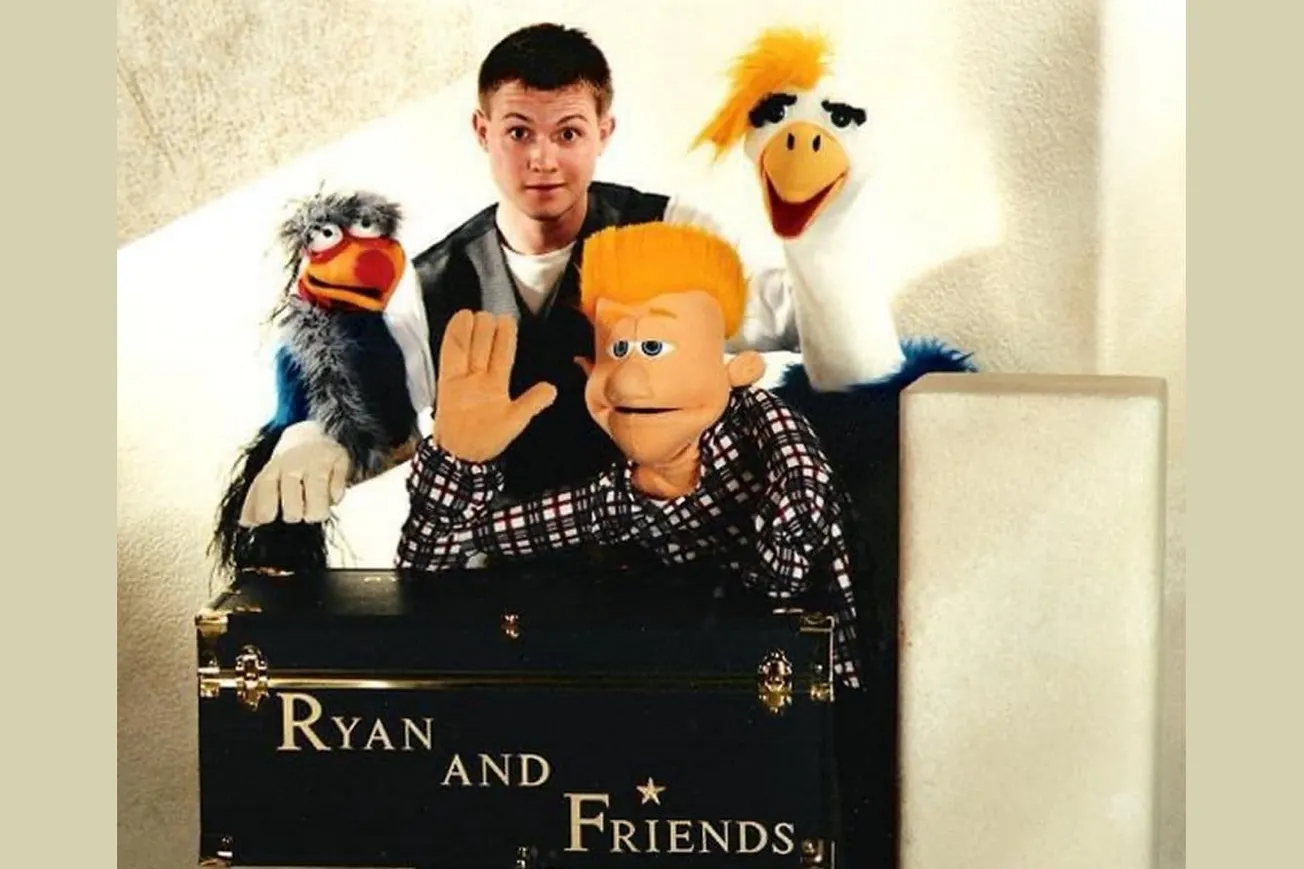
For me, friendship has often been a challenge. In high school I eventually gave up trying to fit in and became friends with puppets. This is not a metaphor. It's a made for Netflix documentary. I literally performed in a ventriloquist show called Ryan & Friends, where every one of my friends had googly eyes, synthetic fur, and was operated entirely by either my right or left hand. In hindsight, perhaps that wasn't the strongest strategy for developing social skills. On the bright side, they never interrupted me, never judged me, and they always laughed at my jokes. Mostly because I was making them.
Friendship is hard and takes work.
There are no guarantees. Sometimes you say the wrong thing. Sometimes you replay every conversation in your head for three weeks. Sometimes you accidentally invite someone to play Legos like you're six years old.
And sometimes...
they say yes.

Through my work at the Center for Trauma and Stress Education, I spend a lot of time studying human connection. Research by psychologist Robin Dunbar suggests that genuine friendships aren't accidental. They require repeated investment and the 11-3-6 rule. About eleven meetups, roughly three hours each, spread over six months to create a genuine friendship.
Friendship isn't found. It's built.
Ironically, that's becoming harder than ever. I've heard the same concern from audiences across the country. People are lonely. Technology has given us incredible ways to stay connected while quietly stealing the skills needed to actually connect.
The numbers tell the same story. The percentage of American adults with no close friends has quadrupled- from 3% in 1990 to 12% in 2021. Meanwhile, the average adult now spends less than three hours each week with friends- less than half of what we did just over a decade ago.
We're surrounded by shallow connections.
We're starving for deep friendship.
I've experienced this myself, and I'm determined, however awkwardly, to push back against that trend.
Looking back, many of my closest friendships started with moments that, at the time, felt downright ridiculous.
There's my nuclear medicine friend, whom I literally met while he was performing a medical procedure on me. At one point I attempted to slide off the exam table to escape (true story), and he looked at me with peak Dad Energy and declared,
"No. You will stay on that table."
Months later we ran into each other at an event, became friends, and he still occasionally uses that same dad voice whenever he thinks I'm getting out of line.
Honestly...
it's comforting. Competent Dad Voice is apparently one of my love languages... which is something else I should probably unpack in therapy.
Then there's the friend I met through work who showed up fifteen minutes late to our first meeting. I have a strict ten-minute rule. For reasons I still can't explain, I waited fifteen. He arrived. I'm certain I was grumpy and fully prepared to dislike him. Instead, he became one of my closest friends.
Then there's another family we met through work who invited us to dinner shortly after we met. One of the very first things their children proudly announced was,
"Our dad pees off the porch!"
At that moment I thought, These are our people. We've loved them ever since.
Maybe that's the secret. Friendship rarely begins with polished conversations. It begins with awkward ones. With missed cues.
With weird invitations.
With children oversharing.
With people deciding that all of that is acceptable.
We need people who see our awkwardness, our quirks, and our spectacular social fumbles...
and instead of sprinting toward the nearest exit...
they smile...
grab a handful of tiny plastic bricks...
and say,
"Sure."
I'm incredibly grateful for the friends who have done exactly that for me. They've seen the weird. The remarkable amount of weird. They've stayed anyway.
So, take the chance. Send the text. Invite someone to coffee. Ask them to dinner.
Or, if you're anything like me... invite them to play Legos.
You never know.
The worst they can do is politely wonder whether “playing Legos” is code for something.
The best they can do is become your friend.